
Delegation in Leadership Isn’t About Offloading Work — It’s About Growing Leaders

Lately I’ve been noticing a familiar pattern in leadership teams.
Leaders feel stretched. Their calendars are full. They’re working hard to keep things moving, often stepping in to get things done quickly and well.
From the outside, it can look like strong leadership.
But over time, it creates a bottleneck.
The leader becomes the place where too many decisions and too much work land. The team’s growth slows down. The leader feels burnt-out, while also not focusing enough on the bigger strategic work.
When we look closer, the issue almost always comes back to delegation.
The Real Challenge with Delegation
Most leaders do delegate. They hand off tasks.
But effective delegation is harder than it looks.
Sometimes it feels faster to just do it yourself.
Sometimes the quality bar feels too high to let go.
Sometimes you genuinely enjoy the work or want to help.
All of that is understandable.
But over time, it creates two problems at once:
Leaders become overloaded
Team members miss opportunities to grow
At the core, delegation isn’t just about handing off work. It’s about creating clear ownership with the right level of support.
Why Delegation Feels so Hard
Most leaders were promoted because they were very good at their work. They were the people who could solve the problem, write the proposal, lead the analysis, or step in when something needed to get done well and quickly. They were the experts who excelled at the tasks.
Delegation requires leaders to make a shift.
Instead of being the person who does the work well, their role becomes helping others learn how to do the work well. That shift can be uncomfortable.
There’s also a practical challenge. Effective delegation often takes more time at first.
If you’re the expert in something, delegating it well usually means:
explaining the context
clarifying what success looks like
walking someone through how to approach it
giving feedback or support along the way
In a busy week, it can feel much faster to just do it yourself and in the short term, sometimes it is. However, over time that decision quietly creates a different problem: the leader becomes the place where too much work and too many decisions land.
Why Delegation Matters in Leadership
When leaders consistently hold onto work, a few predictable things happen. They get stretched too thin and eventually burn out. At the same time, team members start to rely on the leader more than they need to, and growth opportunities end up concentrated with just a few people.
Delegation isn’t just about getting work off your plate. Effective delegation is one of the core leadership practices that helps teams grow and organizations scale.
At its best, delegation does two important things at once.
First, it frees leaders to focus where they are most needed. This includes strategic thinking, decision-making, coordinating across teams, influencing up and across, and enabling others to succeed. These are the highest leverage parts of a leadership role, and they are often the first things to get crowded out when leaders stay too deep in execution.
Second, it creates real growth and ownership opportunities for others. Most organizations say they want people to take more ownership and initiative, but ownership does not appear on its own. It develops when people are trusted with meaningful responsibility for tasks, decisions, and outcomes.
Delegation is how leaders make that happen.
When leaders hold onto work, often without realizing it, those opportunities become uneven. A small group gains experience and visibility, while others stay closer to the edges of the work and have fewer chances to grow.
Over time, this does not just limit individual development. It also weakens the overall capacity, resilience and equity in the team.
A Key Insight About Effective Delegation
One misconception I often see is that delegation means handing something off and stepping away, but effective delegation isn’t abdication.
Delegating well means staying involved in the right way.
Sometimes that means providing clear direction. Sometimes it means coaching someone as they think through a challenge or it simply means offering support and removing obstacles.
The goal isn’t to let go completely. The goal is to help someone else successfully take ownership.
Before you delegate the work, choose your leadership stance.
In other words, ask yourself: What does this person actually need from me on this task, in order to succeed and grow right now?
Too often leaders skip this step and jump straight into either micromanaging or not providing enough context.
When the stance doesn’t match the need, things break down.
We coach someone who really needed clear guidance and direction.
We direct someone who was ready for more team ownership.
Or we assume someone lacks motivation when the real issue is unclear expectations.
A Practical Delegation Framework: The Delegation Arc
Leaders often ask what effective delegation in leadership actually looks like in practice. One simple way to approach it is through four moves:
Choose Your Stance
Create Clarity
Stay Connected
Close the Loop
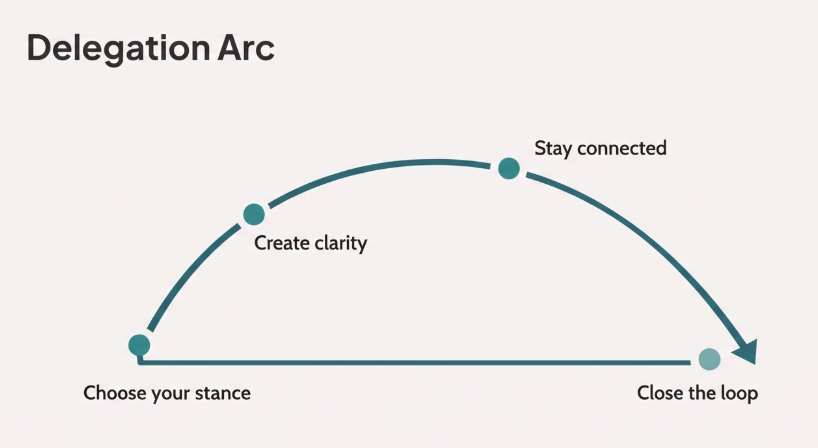
Most delegation challenges happen because one of these steps gets skipped.
Let’s look at the first two.
1. Choose Your Stance
One of the most important leadership delegation skills is knowing how to choose the right level of guidance for each person.
Before delegating, pause and ask:
What does this person need from me right now in order to succeed and grow?
There are three common stances.
1. DIRECTION (for someone less experienced with the area of responsibility)
You provide clear steps, expectations, and guardrails.
What it sounds like:
“Here’s the structure I’d like you to follow for this first draft. Let’s review it together before it goes out.”
2. COACHING (for someone with developing capability in the task)
You provide open questions, thinking partnership, room for the other person to problem-solve.
What it sounds like:
“What approach are you considering?”
“What tradeoffs are you weighing?”
3. SUPPORT (for someone capable and experienced, but struggling with lower motivation for the task)
You provide encouragement, visibility, and help removing obstacles.
What it sounds like:
“You’ve got this. Let me know if anything gets in your way.”
Choosing the right stance is one of the most overlooked leadership skills. It’s also an equity practice. It helps ensure people get the support they actually need, not more or less based on bias or habit.
2. Create Clarity
Once your stance is clear, the next step is building real clarity for the task or responsibility you’re delegating.
Effective delegation usually includes:
What success looks like
Why it matters
What decisions they own (and where to check in)
Timeline and constraints
Available resources
How progress will be reviewed
When one of these is missing, leaders often end up stepping back in later. Not because the person wasn’t capable, but because expectations were never fully clear.
For example:
A leader says:
“Can you put together a proposal for this partnership?”
The team member wonders:
How detailed should this be?
Who needs to review it?
Is this exploratory or final?
When is it actually due?
Without clarity, people either stall or over-check with the leader.
Real-World Moments
In leadership workshops, I often hear things like:
“I feel like I delegated this three times.”
When we look closer, what happened was:
the task was delegated
but the decisions weren’t
and the expectations weren’t fully clear.
Another leader said recently:
“I thought I was empowering my team, but I think I was actually leaving them guessing.”
That insight is often the turning point.
Delegation works when leaders stay involved early, set expectations, share context, provide feedback, and help the person learn and improve.
Over time, that’s how capability grows and the person eventually becomes even stronger at that work than the leader once was.
Leadership Reflection
If delegation has felt harder than it should, consider:
What am I holding onto because it feels faster to do myself?
Where could someone grow if I gave them more ownership?
What stance would best support them right now?
Small shifts in these moments make a big difference.
The Bottom Line
Leadership isn’t just about getting the work done.
It’s about building a team that can do the work well, without everything depending on you.
Delegation is one of the most practical ways to make that happen.
Not by handing things off and stepping away,
but by creating clarity, sharing ownership, and helping others grow.
And like most leadership practices, it improves through small, intentional choices over time.
This is exactly the kind of work we focus on with leadership teams.
At Regroup, we help leaders build the practices that reduce bottlenecks and grow capacity across their teams, things like clear ownership, stronger communication, and developing the next layer of leadership.
Because when delegation works well, leaders aren’t the bottleneck and teams have what they need to succeed.
If you’re thinking about how to strengthen this on your team, we’d be glad to talk.